


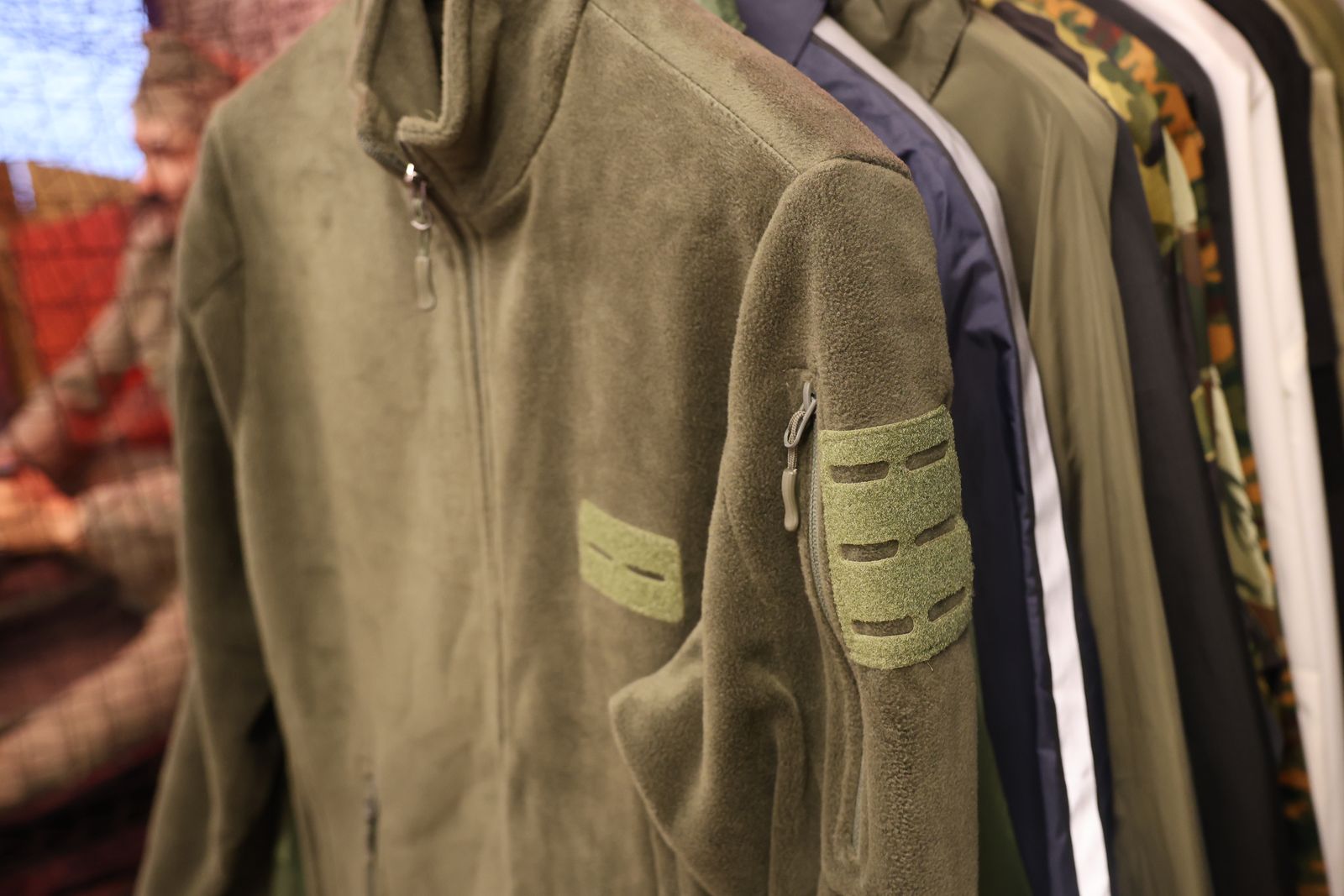
Polar fleece (fleece fabric) is a polyester-based knitted textile brushed on both faces. In defence use it sits as the mid layer of the layered clothing system; thanks to its light weight, high heat-retention capacity and rapid drying, it has largely displaced traditional insulation materials such as goose down and wool.
Polar fleece offers five core advantages in defence use: light weight, rapid drying, breathability, retention of insulation value when wet, and ease of care. This combination of properties makes fleece the mid-layer material of choice across a wide range of applications, from cold-weather operations to mountain missions.
This article sets out, with technical precision, the fabric structure of polar fleece, its weight classes (100, 200, 300 GSM), military applications, leading technology brands and test standards.
The Origins of Polar Fleece and Its Transition into Military Use
Polar fleece was developed in 1979 in the laboratories of Malden Mills (today’s Polartec) under Aaron Feuerstein; not long afterwards it was adapted for outdoor use together with Patagonia’s founder Yvon Chouinard and, in 1981, commercialised in Patagonia’s Synchilla range.
The US Army introduced polar fleece into its official cold-weather clothing system in the early 1990s. In the ECWCS (Extended Cold Weather Clothing System) lineage, when the Gen II system replaced earlier concepts, heavy-class Polartec 300-series fleece jackets (the iconic black model) entered the inventory as the standard mid layer for maximum insulation in extreme cold. With the wider rollout of ECWCS Gen III from the mid-2000s onwards, Level 1 became a lightweight next-to-skin base layer in Polartec Power Dry, Level 2 a mid-weight grid-fabric intermediate layer built from Polartec Power Grid, and Level 3 the system’s primary insulation layer — the ‘High-Loft’ fleece jacket class.
Today, across the German Bundeswehr, the UK Armed Forces and numerous other armies and law-enforcement units, fleece-type solutions are widely used as the mid layer of layered clothing systems. Product types and levels of standardisation vary by country and procurement period.
The Fabric Structure of Polar Fleece
Polar fleece is produced through a technical sequence of knitting, mechanical brushing and shearing that stabilises pile height while preventing pilling at the surface. These steps create a still-air layer between the fibres that provides the core insulation function. These air pockets are the fundamental structure that delivers insulation.
Fibre Structure and Material
In certain special models a Spandex (elastane) addition (typically in the 9–12% band) is introduced to deliver a high four-way stretch. Polartec’s Power Stretch and Power Stretch Pro ranges are the best-known examples, using this elastane band to provide maximum freedom of movement.
The four core material properties of polyester polar fleece are as follows:
- Low water absorption: Polyester has a low moisture regain; combined with the dedicated knit structure, this keeps polar fleece’s air pockets open even when wet (unlike water-retaining fibres such as cotton) and sustains effective thermal insulation and wearer comfort.
- Rapid drying: Because of its low water absorption, polar fleece dries far faster than cotton fabrics. Drying time varies over a wide range with weight, airflow, ambient humidity and the amount of water taken on.
- Light weight: 100 GSM polar fleece weighs around 100 g/m², 300 GSM around 300 g/m². For equivalent insulation it is usually heavier than goose down; though down retains the edge in insulation lifespan, polar fleece is significantly easier to care for in machine washability, repeated compression and mechanical durability in damp conditions.
- Recyclability: Polartec has used recycled polyester in its production since 1993. With environmental compliance requirements rising steadily in military procurement projects, this property has become increasingly important.
Thermal Insulation Mechanism
Polar fleece provides thermal insulation through still-air layers trapped within its fibre structure. Still air is a very low thermal-conductivity insulator, so it slows the heat flow from the body to the surroundings. Insulation performance can be expressed in CLO. In the laboratory, thermal resistance (Rct) is measured in accordance with ISO 11092; the CLO value can be derived from that thermal resistance. For fleece products the CLO range varies with test conditions, fabric weight, pile height and knit geometry.
Compared with naturally absorbent insulators such as cotton and goose down, polar fleece retains most of its insulation capacity when wet. That difference is decisive in prolonged damp-environment operations.
Polar Fleece Weight Classes in Military Use
Polar fleece is divided into three core classes by fabric weight: 100 GSM (g/m²), 200 GSM and 300 GSM. Each class corresponds to a different mission and climate profile.
For a detailed comparison of the CLO, weight and breathability differences between 100, 200 and 300 GSM fleece, please see our military fleece weights guide.
|
Weight |
Mass (g/m²) |
Insulation (CLO) |
Typical military use |
Layering position |
|
100 GSM |
~100 |
0.5–0.8 |
Spring/autumn, mildly cold |
Mid layer or single layer |
|
200 GSM |
~200 |
0.8–1.2 |
Four-season standard mid layer |
Mid layer |
|
300 GSM |
~300 |
1.2–1.8 |
Winter, cold-climate operations |
Primary thermal layer |
100 GSM: Lightweight Mid Layer
100 GSM polar fleece, with its low weight and high breathability, is the class of choice for tasks involving heavy physical activity. In the ECWCS Gen III system the 100 GSM band lines up with the Level 1 lightweight base layer; the heavier Level 2 — at around 230–250 GSM — sits as a denser grid-construction thermal mid layer.
200 GSM: The Standard Military Fleece
200 GSM polar fleece is the most common weight in defence use and offers balanced insulation. That said, the US ECWCS Gen III Level 3 garment does not sit in the standard 200 GSM micro-fleece category; it is a dedicated insulation fabric with maximised breathability and long pile (Polartec Thermal Pro High-Loft), and its knit structure, specific weight and insulation profile differ from standard 200 GSM fleece. In many countries 200 GSM fleece is a common choice in the ‘standard mid layer’ segment; final standardisation varies by national specification and procurement period.
300 GSM: Heavyweight Winter Fleece
300 GSM polar fleece is designed for low-temperature static or low-activity tasks. It is preferred in waiting positions, headquarters duty and in-vehicle operations. Its weight can cause movement restriction in high-tempo tasks; 200 GSM is preferred in those cases.
The 7 Advantages of Polar Fleece in Defence Use
Light Weight and Compact Volume
A 200 GSM-class fleece jacket weighs approximately 350–550 grams depending on model and size, and folds to a strikingly small volume. The zipper, number of pockets and reinforcement panels built into the design influence this total weight markedly. Reducing carried load on prolonged field operations translates directly into performance gains. In the UK Armed Forces’ PCS (Personal Clothing System), the lightweight thermal shirts and the dedicated mid layer known as the ‘Thermal Fleece Jacket’ (not classic pile-faced fleece but 100% polyester fleece or a ripstop-nylon construction with a micro-fleece-textured inner face, supplied by non-Polartec-branded vendors) take up minimal room in the kit bag thanks to their high warmth-to-weight ratios.
Retaining Insulation Capacity When Wet
Polyester polar fleece retains most of its insulation capacity when wet. That property delivers a major operational advantage, particularly against materials like goose down, which lose volume and insulation value once saturated. While high-performance natural fibres such as wool also insulate when damp, polyester fleece does not soak up water into its structure; as a result it does not become heavy like wool when wet, retains its insulation capacity and keeps personnel mobile. In long-duration rain operations and maritime operations that difference is decisive.
Rapid Drying
Polar fleece sheds the moisture, sweat and precipitation that work into the fabric under the heavy-use conditions of the defence environment. Because polyester fibres retain a minimum of water, 200 GSM fleece dries quickly in adequate airflow and restores operational comfort for personnel in short order. Since field drying opportunities are limited, this property is of operational importance.
Breathability
Because polar fleece is not a closed-membrane fabric, it has a high level of natural breathability. Moisture vapour leaving the body during heavy physical activity can escape through the fabric layers without obstruction. In high-tempo tactical operations, mountaineering and evacuation tasks, this property prevents the build-up of internal moisture and reduces the risk of hypothermia.
Compatibility with the Layering System
Polar fleece serves as a bridge between base layer and outer shell in the military layering system, functioning as the mid layer. The layering approach relies on several layers of different function working together rather than a single heavy layer: the base layer manages moisture, the mid layer retains heat, the outer layer reduces the effects of wind and rain. Correct selection of each layer in the layering approach delivers thermal protection across a much wider temperature and activity band than a single heavy garment. Use of polar fleece as an outer layer is not recommended; its resistance to wind and rain is low.
Ease of Care
Polar fleece is machine-washable at 30–40 °C and can be tumble-dried on a low setting. Compared with goose down, which requires gentle wet-washing with a specially formulated liquid detergent (down is never dry-cleaned, because dry-cleaning chemicals strip the feathers’ natural protective oils and destroy loft permanently), or with wool, which needs special care, polar fleece is far more practical in field conditions. Ease of care is of major importance in military procurement; in the field, a garment that can be washed and dried quickly directly eases supply processes and the management of the operational cycle.
Durability and Long Service Life
Polyester polar fleece shows higher mechanical strength than wool and natural fibres. Pilling is a well-known disadvantage of fleece fabrics; however, Polartec’s high-tenacity range and anti-pilling fleece constructions with low pile height significantly reduce the problem. In the context of military equipment design life, long-service performance depends on factors such as pilling resistance, seam strength and surface abrasion resistance. In defence use the goal is to extend service life with constructions and finishes that delay functional loss under repeated washing and abrasion cycles.
Military Polar Fleece Technologies and Brands
Polartec
Polartec (formerly Malden Mills) is the benchmark brand of military polar fleece technology. The Polartec ranges used across several layers of the US Army’s ECWCS Gen III system are as follows:
- Polartec Power Dry: Designed for base-layer and first-layer fleece use with its two-way moisture transport construction. It pulls moisture at the surface quickly to the outer layer.
- Polartec Thermal Pro: Developed specifically for Level 3 main-insulation applications; its High Loft variant delivers maximum warmth retention through its high thermal efficiency per unit weight and bulky construction (ECWCS Gen III Level 2 uses Polartec Power Grid technology).
- Polartec Power Stretch: A polyester/Spandex four-way stretch construction; used in combat and tactical operations clothing both as a mid layer and as simple outerwear.
- Polartec Alpha: An active-insulation range developed directly for the US Special Operations Command (USSOCOM); the core reason for its development for Special Operations units is to deliver an active insulation that removes the need for personnel to repeatedly add and remove layers between static (ambush/standby) and dynamic (engagement/infiltration) states, maintaining comfort in both regimes within a single layer. Alpha Direct is the version of this original military technology modified for the civilian market so that no inner liner is required. In comparative testing, the Polartec Alpha and Alpha Direct ranges stand out from traditional polar fleece through their active-insulation approach. Designed to reduce moisture build-up during physical effort and keep the heat-moisture balance stable, this construction delivers a markedly better comfort profile in high-tempo tasks than classic models.
Schoeller Textiles
The Switzerland-based Schoeller Textiles stands out in the military polar fleece segment with its stretch-built softshell and fleece combinations. Schoeller’s WB-400 range is a two-sided construction that pairs wind and water resistance on the outer face with fleece comfort on the inner face. In certain scenarios this construction can help reduce the layer count; however, in heavy rain and high-wind conditions a separate outer shell requirement may persist depending on the mission profile.
Other Military Polar Fleece Suppliers
Other brands prominent in the military polar fleece market include:
- Helikon-Tex: A brand widely known in the tactical clothing market; in particular, models such as the Patriot Heavy Fleece Jacket draw attention for their twin-layer 390 g/m² construction, which delivers high thermal insulation.
- Raff Military Textile: Türkiye-based defence textile manufacturer; Raff Military Textile supplies military polar fleece production in 100, 200 and 300 GSM, offering bespoke solutions such as camouflage or solid-colour production per customer requirement and customised rank and patch-area design. Production is carried out with fabric and test criteria matched to the technical specification.
You can review the technical detail of the military fleece models produced by Raff Military Textile on our military fleece category page.
Test Standards for Military Polar Fleece
The performance of military polar fleece fabrics is measured against five core parameters and the related test standards:
|
Parameter |
Test standard |
Typical target value |
Significance |
|
Thermal insulation (CLO) |
ISO 11092 |
200 GSM: 0.20–0.40 CLO |
Defines temperature range |
|
Moisture transport (MVTR) |
ASTM E96 |
>20,000 g/m²/24 h |
Controls moisture build-up |
|
Air permeability |
ISO 9237 |
Medium to high permeability |
Breathability |
|
Bursting strength |
ISO 13938-2 (or ASTM D3786) |
Dependent on fabric weight |
Mechanical durability |
|
Colour fastness (wash) |
ISO 105-C06 |
4–5 (Grey Scale) |
Camouflage colour stability |
In mid-layer fabrics, breathability and thermal comfort are assessed through measurable test parameters. ISO 11092 measures water-vapour resistance (Ret) and thermal resistance (Rct); the lower the Ret value, the less resistance there is to water-vapour transmission, and the more readily the garment moves moisture out. Acceptance thresholds are defined by the technical specification of the procuring authority, and those specifications fix moisture-transmission resistance (Ret) and thermal insulation (CLO) limits precisely. The lower the Ret value, the more breathable the fabric.
Camouflage and Design in Military Polar Fleece
Camouflage Printing
Polar fleece, because of its high pile, is not directly suited to standard reactive or pigment printing; camouflage colouration is therefore generally applied by one of two methods:
- Piece dyeing: The entire fabric surface is dyed in a single solid colour. Military solid colours (OD green, grey, black, coyote brown) are produced this way. This is the most common military fleece type.
- Camouflage printing: Because the pile (napped) synthetic construction of fleece is not suited to reactive printing, camouflage patterns are generally applied by high-temperature sublimation (transfer) printing; in this method disperse dyes pass into a gas phase, work into the polyester fibres and deliver a permanent colour. UK MTP and German Flecktarn camouflage-printed polar fleece products use this technique; however, pattern definition remains slightly softer than prints applied to flat-woven fabrics.
Structural Design Features
In a military polar fleece jacket design, four standard equipment features are considered:
- Zipper: Full-length YKK or equivalent-quality zipper; an internal wind baffle to prevent wind ingress.
- Pocket configuration: Chest and side pockets; some models feature a high-position hand pocket suited to wear beneath a plate carrier.
- Cuff, hem and reinforcements: Thumb-hole elasticated cuffs that stop the sleeves from riding up when worn beneath the outer shell; an adjustable drawcord at the hem; high-durability reinforcement panels at the shoulder and elbow to resist wear from rucksack straps and friction.
- Velcro and patch areas: Velcro attachment panels at the shoulder and chest for rank and patches.
The Role of Polar Fleece in the Layering System
Polar fleece sits in the second or third layer of the military layering system and is used in the following combinations:
- Cold-weather combination: Base layer (Polartec Power Dry) + 200 GSM polar fleece + hardshell (GORE-TEX laminate) outer shell. This is the baseline winter configuration of ECWCS Gen III.
- Moderate-cold combination: Base layer + 100 GSM polar fleece + softshell outer shell. For moderate weather and tasks requiring high activity.
- Extreme-cold combination: Base layer + 200 GSM polar fleece + hardshell outer shell + synthetic-fill heavy parka (PrimaLoft or G-LOFT). In military doctrine (e.g. ECWCS Level 7) heavy insulation parkas, to avoid loss of loft, are not worn beneath the hardshell but over the entire system as the outermost layer when required. For operations at −30 °C and below.
Using polar fleece alone as outerwear is not recommended, because its protection against wind and rain is inadequate. Insulation value drops rapidly in wind; that weakness can only be offset by a suitable wind barrier (softshell, hardshell or windshell) worn over it.
Comparison of Polar Fleece with Other Insulation Materials
A comparison of polar fleece with other military mid-layer materials:
|
Property |
Polar fleece (200 GSM) |
Goose Down (600 FP) |
Synthetic fill (PrimaLoft) |
Wool |
|
Weight |
Medium |
Very light |
Light (notably lighter than polar fleece at equivalent CLO) |
Heavy |
|
Insulation when wet |
Good |
Very poor |
Good |
Very good (generates heat via exothermic reaction when wetting) |
|
Fast drying |
Very good |
Slow |
Good |
Slow |
|
Breathability |
Very high |
High |
Medium to high |
Medium |
|
Compactability |
Medium |
Very good |
Good |
Low |
|
Ease of care |
Very easy |
Difficult |
Easy |
Medium |
|
Cost (relative) |
Low |
High |
Medium to high |
Medium |
Goose down offers the highest insulation per unit weight in dry conditions; but once wet it loses most of its insulation value and is hard to dry. Polar fleece is an easy-care, cost-effective alternative that does not carry either of those two critical drawbacks. Synthetic fills such as PrimaLoft Silver come close to polar fleece for wet-insulation performance, but their breathability is lower.
Conclusion
Since its development in 1979, polar fleece has become the core material of military mid-layer clothing. While in the traditional winter layering kits of many NATO countries 200 and 300 GSM polar fleece is used as the standard mid layer, in modern systems like the US Army’s ECWCS Gen III (Level 3), to save weight and volume, ‘High-Loft’ (high-volume, long-pile) fleece technologies are specified as the standard mid layer instead of standard-weight fleece.
The three defining advantages of polar fleece in defence use are: largely retaining insulation capacity when wet, rapid drying and ease of care. Those properties deliver logistic and operational advantages over traditional materials such as goose down and wool. Across three weight classes — 100 GSM lightweight mid layer, 200 GSM standard winter fleece and 300 GSM heavyweight winter fleece — the material adapts to different climates and mission types.
With its ISO 9001:2015- and Oeko-Tex-certified production infrastructure, Raff Military Textile supplies polar fleece in 100, 200 and 300 GSM weight options, with bespoke camouflage and solid-colour options, and STANAG-compatible fabric supply, exporting to more than 60 countries.
Frequently Asked Questions
What is polar fleece?
Polar fleece is a polyester-based fabric with a knit construction brushed on both faces. The air pockets between the fibres deliver thermal insulation; the polyester construction retains insulation capacity when wet and dries quickly.
What is the difference between military polar fleece and standard polar fleece?
Military polar fleece is distinguished from civilian standards by camouflage printing, high colour fastness, mechanical strength, pilling (knotting) control and ergonomic pattern details suited to field use. In defence procurement all of these structural differences — including weight, thermal resistance and accessory durability — are defined precisely by the procuring authority’s formal technical specifications. Test methods and acceptance limits are fixed according to the procuring authority’s documentation.
Should 200 GSM or 300 GSM fleece be chosen?
200 GSM polar fleece should be chosen for active physical tasks and moderate-cold climates, while 300 GSM should be chosen for static and low-activity tasks together with extreme-cold climates. In high-tempo operations 300 GSM can cause movement restriction.
Can polar fleece be used as outerwear?
Yes, in limited conditions. In dry, rain-free and wind-free cold conditions (for example inside a headquarters building or at sheltered static observation posts) it can be worn alone as the outermost layer to provide high breathability. However, in windy or wet operational conditions it loses insulation value quickly because there is no wind barrier; in such conditions a protective outer shell — a softshell, hardshell or a suitable windproof — must be worn over it.
What is the difference between Polartec and Polartec Alpha?
Polartec Alpha, unlike standard polar fleece, has an open-pore synthetic-fill construction. Breathability on the move is significantly higher; while standard polar fleece works with still-air pockets, Polartec Alpha permits active airflow and reduces moisture build-up. Polartec Alpha was developed directly for the US Special Operations Command (USSOCOM) as a single-layer active-insulation solution that removes the need for personnel to continuously add and remove layers between static (ambush/standby) and dynamic (engagement/infiltration) states.
Does Raff Military Textile produce camouflage-printed polar fleece?
Yes. Raff Military Textile produces polar fleece to the camouflage pattern, colour palette and weight specified by the customer. Customised patch and rank-area design is offered alongside a STANAG-compatible fabric option.