


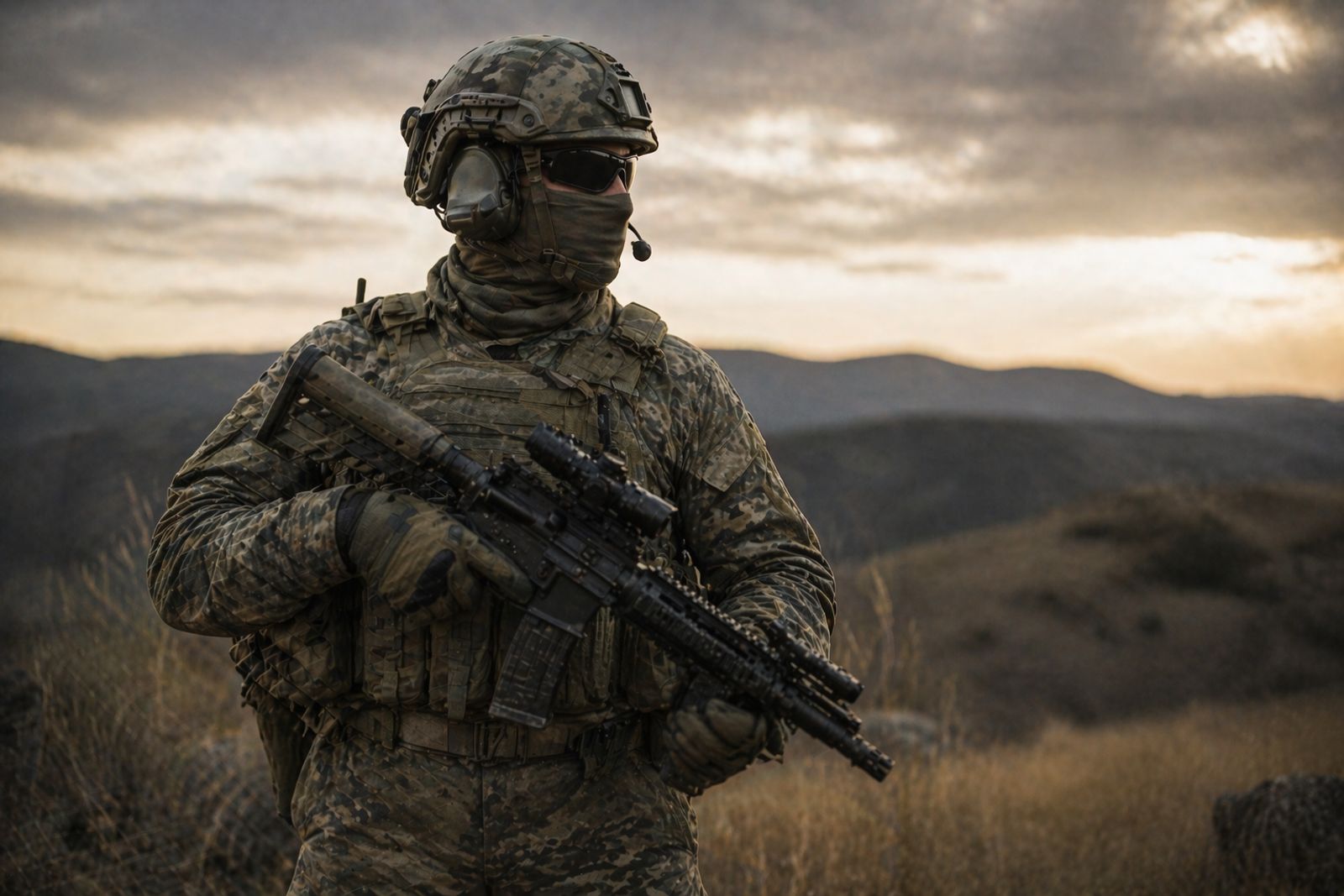
A combat uniform is a specialist functional clothing system designed for military combat operations, optimising camouflage, durability, and freedom of movement. The anatomy of battle dress encompasses eight fundamental components: upper garment (shirt/jacket), lower garment (trousers), headwear (cap/beret), footwear (boots), protective equipment (body armour/knee pads), load-carrying system (belt/harness), accessories (gloves/socks), and camouflage pattern. The combat uniform includes standard systems such as ACU (Army Combat Uniform), BDU (Battle Dress Uniform), and OCP (Operational Camouflage Pattern).
This guide offers four principal benefits: identifying combat uniform components, understanding technical specifications, learning selection criteria, and grasping operational applications. The combat uniform is used by infantry units, special forces, armoured units, aviation personnel, and support units. Its core components comprise fabric technology, ergonomic design, modular systems, and standards compliance. Combat uniform standardisation follows NATO STANAG 2333, which establishes the overall performance and protective property standards for combat clothing, and MIL-DTL-44436, which defines the fabric technical specifications.
Combat Uniform Definition and Historical Development
A combat uniform is a clothing system engineered to maximise military personnel performance under combat conditions. Unlike ceremonial uniforms, the combat uniform prioritises functionality, durability, and concealment. Visual aesthetics are secondary. The combat uniform began to develop at the start of the 20th century and has evolved in response to modern warfare requirements.
Historical development is classified into five periods: pre-First World War (1900–1914) plain-coloured uniforms, the First World War (1914–1918) initial camouflage experiments, the Second World War (1939–1945) systematic camouflage use, the Cold War era (1945–1991) advanced fabric technologies, and the Modern era (1991–present) digital camouflage and smart textiles. Prior to the First World War, military uniforms employed bright colours (red, blue). During the Second World War, the German Wehrmacht standardised systematic camouflage pattern usage, whilst the US M1943 uniform established the foundational standards of functional design, layered clothing systems, and ergonomic construction that underpin modern battle dress.
The modern combat uniform exhibits three generations of technology: Gen 1 (1990–2005) traditional camouflage patterns, Gen 2 (2005–2015) digital camouflage and advanced fabrics, and Gen 3 (2015–present) multi-spectral camouflage and smart textiles. The US Army Combat Uniform (ACU) was introduced in 2005 using the Universal Camouflage Pattern (UCP). In 2015, a transition was made to the Operational Camouflage Pattern (OCP) / MultiCam. Combat uniform evolution continues in response to changes in adversary weapon technology and operational environments.
These three generations differ from each other in material science, ergonomic solutions, stitch quality (SPI) and interactions with load-bearing equipment. Each generation’s design choices were shaped by the operational lessons and material-technology advances of its era.
To deeply explore the engineering differences between Gen 1, Gen 2, and Gen 3 combat uniforms, you can read our technical evolution guide for Gen 1, Gen 2, and Gen 3 combat uniforms.
Upper Garment: Combat Shirt and Jacket Anatomy
The combat shirt provides upper-body protection and equipment carriage functionality. A standard combat shirt contains 8–10 functional features: chest pockets (2), sleeve pockets (2), elbow reinforcement, adjustable cuffs, collar closure, shoulder Velcro panels (for rank/name), chest Velcro panels (for flag/name), and ventilation eyelets. Modern combat shirt designs feature a torso section of stretch fabric providing moisture transfer for wear under body armour, with sleeves of durable woven fabric; the shirt is worn tucked into the trousers for operational comfort.
The combat jacket is worn during adverse weather conditions and operations requiring additional protection. Combat jacket features encompass six additional components: inner lining (thermal or mesh), hood (removable or stowable), waist adjuster, internal pockets (for maps/communications devices), sleeve pocket expansion, and lower-waist pockets. The combat jacket serves as the outer layer of the layering system. The M65 Field Jacket is the classic combat jacket design; introduced in 1965, it served as the standard for the US Army for decades before being officially retired and replaced by modern ECWCS layering systems.
Elbow reinforcement employs two techniques: double-layer fabric and protective pad pockets. Double-layer fabric increases abrasion resistance. The protective pad pocket accommodates hard-surface elbow support and features a removable insert design. Cuff adjustment is achieved through Velcro or button systems. Velcro cuffs provide rapid adjustment. Button cuffs offer traditional and silent closure. Combat shirt weight ranges from 180 to 220 g/m² (5.3–6.5 oz/yd²) and varies by season.
Lower Garment: Combat Trouser Features
The combat trouser is designed for lower-body mobility and knee-pad protection. A standard combat trouser contains 10–12 functional pockets: front pockets (2), rear pockets (2), side cargo pockets (2, large), knee pockets (2, small), and waist pockets (1–2, small). Total pocket count ranges from 8 to 12. Cargo pockets are optimised for carriage of equipment such as magazines, maps, medical supplies, and torches.
The knee protection system employs three design approaches: internal knee-pad pocket, external knee-pad attachment, and articulated knee design. The internal knee-pad pocket permits the insertion of hard protective pads. External attachment enables the fitting of removable knee pads. Articulated knee design incorporates a pre-curved cut that conforms to knee movement. Articulated knees increase squatting and running comfort by 25–35%.
The waist system offers two configurations: belt loops or an integrated belt. Belt loops require the use of a standard tactical belt and accommodate widths of 38–50 mm (1.5–2 in). The integrated belt incorporates a fixed internal belt and provides rapid donning. Leg-hem adjustment encompasses three methods: button, Velcro, or drawcord. Button adjustment provides leg taper for boot integration. Velcro adjustment offers rapid and adjustable fit. Combat trouser weight ranges from 200 to 240 g/m² (5.9–7.1 oz/yd²).
Combat Uniform Fabric Technologies
Combat uniform fabrics employ NyCo (Nylon–Cotton blend), PolyCo (Polyester–Cotton blend), and Ripstop weave technology. The NyCo 50/50 blend meets the requirements of US military standard MIL-DTL-44436. Nylon provides high durability and abrasion resistance. Cotton offers comfort and moisture absorbency. NyCo fabric weight ranges from 195 to 225 g/m² (5.8–6.6 oz/yd²).
Ripstop weave incorporates a grid reinforcement structure and arrests tear propagation. Ripstop grid spacing measures 5–8 mm (0.2–0.3 in). Reinforcement yarns are 30–50% thicker than the base fabric. Ripstop achieves equivalent durability at 20–30% lower weight. Combat uniform durability tests encompass ASTM D1424 (tear strength) and the Martindale abrasion test. The acceptance criterion is 45+ Newton tear strength and 50,000+ cycle abrasion resistance.
Advanced fabric technologies offer four properties: moisture management, flame retardancy, water repellency, and IR protection. Moisture management optimises evaporation by rapidly spreading perspiration across the fabric surface; in woven combat fabrics, this performance is comprehensively measured through a combination of air permeability, moisture wicking rate tests, and the Moisture Vapour Transmission Rate (MVTR), which quantifies the fabric’s ability to expel perspiration vapour. Flame-retardant fabrics exhibit self-extinguishing properties and in military applications generally meet ASTM D6413 (Vertical Flame Test) or the relevant MIL-SPEC FR standards. DWR (Durable Water Repellent) coating causes water droplets to bead on the surface. IR protection encompasses NIR (Near-Infrared) reflectance control.
You can use our combat uniform selection guide to learn step by step how fabric features such as weight, weave type, DWR, NIR, and flame resistance should be chosen according to mission type and climate conditions.
Combat Uniform Camouflage Pattern Systems
The camouflage pattern provides the visual concealment function of the combat uniform and is optimised according to terrain type. Five main camouflage categories exist: Woodland, Desert, Digital (MARPAT, CADPAT), Multi-Terrain (MultiCam, OCP), and Urban. Each category is compatible with different terrain and climatic conditions.
Digital camouflage employs pixel-based patterns and creates optical illusion effects. Pixel dimensions range from 3 to 15 mm (0.12–0.59 in). MARPAT (Marine Pattern) was introduced by the US Marine Corps in 2002 and officially uses Woodland and Desert variants (the Urban variant was tested but never entered standard inventory). CADPAT (Canadian Disruptive Pattern), the world’s first digital camouflage system, was fielded by the Canadian Armed Forces in 1997. Digital camouflage provides 12–18% more effective concealment than traditional camouflage.
MultiCam is a multi-environment camouflage system developed by Crye Precision. MultiCam uses seven colour tones and achieves compatibility across different terrain types. The US Army adopted the MultiCam (OEF-CP) pattern in 2010 as an interim solution for operations in Afghanistan; in 2015, it transitioned to the OCP (Operational Camouflage Pattern) system based on the Scorpion W2 pattern — closely resembling MultiCam but owned by the US Government — making it the standard. MultiCam variants include Arid (dry climate), Tropic (tropical climate), Alpine (snow) and Black (night operations). Combat uniform camouflage selection affects operational effectiveness by 30–40%.
You can find the historical development, technical specifications, and comparative analysis of official U.S. military uniform standards such as ACU, BDU, MCCUU, and OCP in our ACU, BDU, MCCUU, and OCP military uniform standards guide.
The MOLLE System and Modular Equipment Integration
MOLLE (Modular Lightweight Load-carrying Equipment) provides the integration of the combat uniform with tactical equipment. The MOLLE system uses PALS (Pouch Attachment Ladder System) webbing straps. The PALS system consists of 25 mm (1 in) wide horizontal columns with vertical stitches at 38 mm (1.5 in) intervals; this standard dimension ensures the universal compatibility of all modular accessories. The straps are stitched onto uniforms and equipment.
MOLLE integration encompasses four applications: tactical vest, rucksack, belt system, and combat trousers. The tactical vest incorporates MOLLE straps across the chest and back. Equipment such as magazine pouches, grenade pouches, and water bottle pouches is integrated onto the vest or belt via the MOLLE system. The rucksack features MOLLE panels on its side and front surfaces. The belt system carries PALS-compatible pouches and holsters. Combat trousers may incorporate MOLLE straps on the side cargo pockets.
MOLLE alternatives include Velcro systems and quick-attach clips. Velcro systems provide rapid attachment and removal but lose effectiveness with sand and dirt contamination. Quick-attach clips include systems such as QASM (Quick Attach Surface Mount), developed by ITW Nexus, and Duraflex. The MOLLE system provides modular flexibility and allows configuration changes according to mission type. Combat uniform MOLLE integration increases personnel load-carrying capacity by 40–60%.
Combat Uniform Ergonomics and Movement Analysis
Ergonomics optimises the combat uniform’s conformity to human body movements. Six movement parameters are assessed: arm elevation range, knee flexion angle, shoulder rotation, torso rotation, squat depth, and walking/running stride length. The combat uniform must not create restriction in these movements and should provide 95% freedom of movement.
Ergonomic design techniques encompass five applications: gusset panels, articulated cuts, stretch fabric inserts, adjustable components, and anatomical fit. Gusset panels place diamond-shaped fabric inserts at the underarm and crotch areas, increasing range of motion. Articulated cuts apply pre-curved designs at the elbow and knee sections. Stretch fabric inserts are typically composed of high-tenacity four-way stretch fabrics, providing flexibility and reducing friction in areas of intensive movement.
Combat uniform comfort factors include thermal regulation and load distribution. Thermal regulation features provide high breathability and moisture transfer, assisting in maintaining stable core body temperature during operational activity and minimising heat stress. Ventilation eyelets are placed at the underarm and back areas. Mesh lining enhances airflow. Load distribution balances equipment weight across the shoulder and waist areas. Combat uniform ergonomics reduces operational fatigue by 15–25% and extends mission duration.
Combat Uniform Standards and Test Protocols
Combat uniform standards define quality control and operational requirements.
Four main standard categories exist: NATO standards (STANAG), US military specifications (MIL-SPEC), international textile standards (ISO, ASTM), and national military regulations. NATO STANAG 2333 is the foundational protocol establishing the overall performance and protective property standards for combat uniforms; MIL-DTL-44436 defines combat uniform fabric specifications.
Test protocols encompass six assessment areas: fabric durability, colour fastness, dimensional stability, tear strength, abrasion resistance, and functional performance. Fabric durability is measured by ASTM D5034 (tensile strength). Colour fastness encompasses the ISO 105 test series (wash, UV, friction). Dimensional stability requires a maximum of 3% shrinkage after washing. Tear strength is tested using ASTM D1424, with an acceptance criterion of 45+ Newton.
Field tests evaluate combat uniform performance under real operational conditions. Test parameters encompass five factors: movement comfort, thermal comfort, durability, camouflage effectiveness, and user satisfaction. Field tests last 6–12 months and are repeated across different climate zones. Test participants wear the combat uniform daily and provide feedback. The combat uniform development cycle implements improvements based on field test results.
Conclusion
The combat uniform is a functional clothing system designed for combat operations. The anatomy of battle dress encompasses eight fundamental components: upper garment (shirt/jacket), lower garment (trousers), headwear, footwear, protective equipment, load-carrying system, accessories, and camouflage pattern. The historical development of the combat uniform has evolved from pre-First World War plain colours to modern digital camouflage. ACU (Army Combat Uniform) and BDU (Battle Dress Uniform) are fundamental combat uniform cuts and designs; OCP (Operational Camouflage Pattern) is the current camouflage pattern applied to these uniforms.
Standard combat jackets incorporate 4 to 6 functional pockets, whilst modern ‘Combat Shirt’ designs intended for wear under body armour omit chest pockets entirely and are generally limited to just 2 sleeve pockets. The combat trouser encompasses cargo pockets, a knee protection system, and articulated knee design within a 10–12 pocket configuration. Combat uniform fabrics employ an NyCo 50/50 blend and Ripstop weave technology. Weight ranges from 195 to 225 g/m² (5.8–6.6 oz/yd²). Advanced fabric technologies provide moisture management, flame retardancy, and IR protection.
Camouflage pattern systems encompass woodland, desert, digital, and multi-terrain categories. MultiCam/OCP achieves multi-terrain compatibility with seven colour tones. The MOLLE system provides modular equipment integration using PALS straps. Combat uniform ergonomics optimises freedom of movement through gusset panels, articulated cuts, and anatomical fit. Combat uniform standards follow NATO STANAG 2333 and MIL-DTL-44436 specifications. Test protocols encompass durability, colour fastness, and field tests. The combat uniform maximises personnel performance and safety in modern combat operations.
Raff Military Textile manufactures combat uniforms engineered for maximum operational performance. Explore our full range of combat uniforms.